
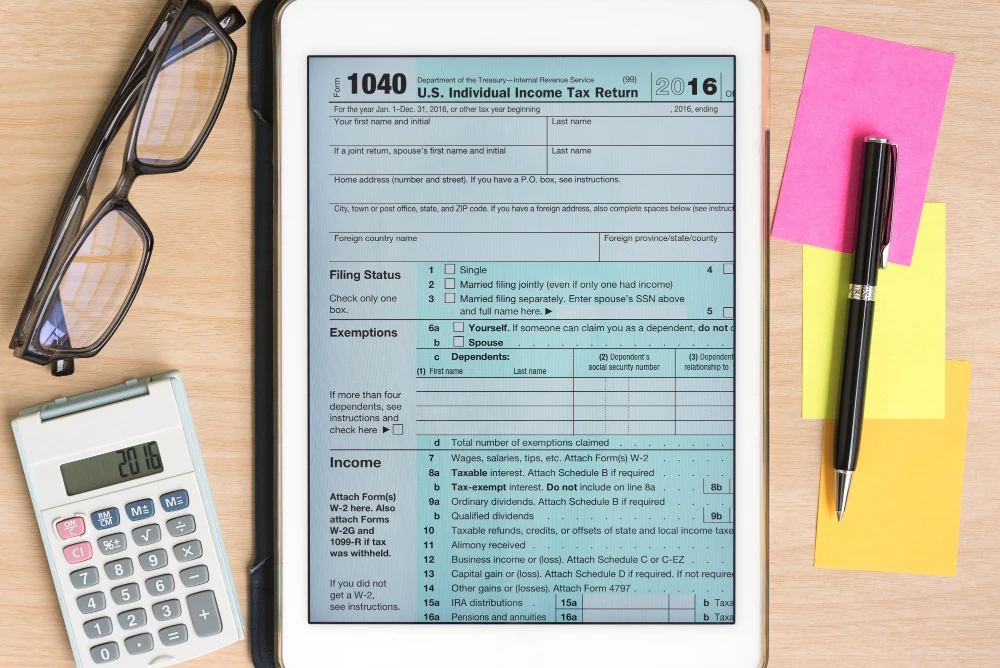
Quick Answer: Form 1040 is the standard IRS form used by U.S. taxpayers to file their annual federal income tax return. For the 2025 tax year, returns are due April 15, 2026. The 2025 form includes a brand-new Schedule 1-A, updated standard deductions, revised tax brackets, and expanded digital asset reporting.
Tax season can feel overwhelming, but understanding Form 1040 for 2025 tax year doesn’t have to be. This guide walks you through everything — what the form is, what’s changed for 2025, how to fill it out section by section, key deadlines, and the most common mistakes to avoid.
Whether you’re a W-2 employee, freelancer, retiree, NRI, or first-time filer, this is your one-stop resource for filing a complete and accurate 1040 return for tax year 2025 (filed in 2026).
What Is IRS Form 1040?
IRS Form 1040, officially titled “U.S. Individual Income Tax Return,” is the primary federal tax form used by U.S. citizens and resident aliens to report annual income, claim deductions and credits, and calculate how much tax they owe — or what refund they’re entitled to.
It’s filed once a year and covers income earned from January 1 to December 31 of the tax year. Almost every American with reportable income must file it, regardless of age or employment type.
A related form, Form 1040-SR, is available for taxpayers aged 65 and older. It uses larger print but follows the same schedules and instructions as the standard 1040. Non-U.S. residents file Form 1040-NR instead.
Who Must File Form 1040 for 2025?
In general, you must file a 2025 Form 1040 if your gross income exceeds the following thresholds. These figures are set by the IRS Publication 501:
| Filing Status | Filing Threshold (2025) |
| Single (under 65) | $15,000 |
| Single (65 or older) | $16,550 |
| Married Filing Jointly (both under 65) | $30,000 |
| Married Filing Jointly (one spouse 65+) | $31,550 |
| Married Filing Jointly (both 65+) | $33,100 |
| Married Filing Separately | $5 |
| Head of Household (under 65) | $22,500 |
| Head of Household (65 or older) | $24,050 |
| Qualifying Surviving Spouse (under 65) | $30,000 |
You may also need to file if you had self-employment income over $400, received advance premium tax credits, owe household employment taxes, or had income from a foreign source.
Key Changes to Form 1040 for Tax Year 2025
The 2025 version of Form 1040 includes several significant updates. Here’s what’s new and how it may affect your return.
1. Brand-New Schedule 1-A: Additional Deductions
New for 2025: Schedule 1-A is an entirely new attachment to Form 1040, introduced specifically for the 2025 tax year.
Schedule 1-A allows taxpayers to claim specific “above-the-line” deductions that were not previously available in this form. Eligible deductions on Schedule 1-A include:
- Qualified cash tips (deductible tip income reported to your employer)
- Qualified overtime pay deductions
- Qualified vehicle loan interest for working-class filers
- Enhanced standard deduction for seniors (age-related bonus)
This is a high-value addition that many filers may overlook. If any of these apply to you, make sure to pull Schedule 1-A when filing.
2. Updated Standard Deduction Amounts
The IRS adjusts the standard deduction annually for inflation. For the 2025 tax year, the standard deduction increased across all filing statuses:
| Filing Status | 2024 Standard Deduction | 2025 Standard Deduction | Change |
| Single | $14,600 | $15,000 | +$400 |
| Married Filing Jointly | $29,200 | $30,000 | +$800 |
| Married Filing Separately | $14,600 | $15,000 | +$400 |
| Head of Household | $21,900 | $22,500 | +$600 |
These higher amounts mean more of your income is shielded from federal tax if you take the standard deduction rather than itemizing.
3. Adjusted 2025 Federal Income Tax Brackets
The seven tax rates (10%, 12%, 22%, 24%, 32%, 35%, 37%) remain unchanged, but the income thresholds are inflation-adjusted upward for 2025. This means more income is taxed at lower rates compared to 2024. Refer to IRS Revenue Procedure 2024-40 or the 2025 Form 1040 instructions for the complete bracket tables by filing status.
4. Expanded Digital Asset Reporting
The IRS has strengthened its crypto and digital asset question on Form 1040. For 2025, you must answer “Yes” or “No” to the question: “At any time during 2025, did you receive, sell, exchange, or otherwise dispose of any digital assets?”
This question now covers a wider range of digital transactions, including NFTs, stablecoins, and crypto received as payment for services. The IRS has published detailed guidance on digital asset reporting — answering “No” when transactions occurred can trigger penalties and audits.
5. Lower 1099-K Reporting Threshold
Starting in 2025, the threshold for receiving a Form 1099-K from third-party payment processors (PayPal, Venmo, Cash App, Etsy, eBay, etc.) has been lowered to $600 — down from the prior $20,000 / 200 transaction threshold.
If you sold goods or received business payments through these platforms and crossed $600, expect a 1099-K in the mail. This income must be reported on your 1040 even if you didn’t receive the form.
6. Updates to Schedules 1, 2, and 3
- Schedule 1 (Additional Income and Adjustments): Now includes more detailed educator expenses, alimony from post-2018 agreements, and gig economy income lines.
- Schedule 2 (Additional Taxes): Clearer guidance on self-employment tax, Net Investment Income Tax (NIIT), and the Additional Medicare Tax.
- Schedule 3 (Additional Credits and Payments): Updated to reflect expanded EV credits, clean energy home improvement credits, and foreign tax credit adjustments.
Section-by-Section Breakdown of Form 1040
Here’s a plain-English walkthrough of each major section of the 2025 Form 1040. You can download the current Form 1040 PDF directly from the IRS to follow along.
Part 1: Personal Information (Lines 1–7)
This is where you enter your name, address, Social Security Number (SSN), and filing status. Double-check your SSN — a single digit error can delay your return by weeks. Your filing status determines your tax bracket, standard deduction, and eligibility for certain credits. Use the IRS Interactive Tax Assistant if you’re unsure of your correct filing status.
Part 2: Income (Lines 1a–15)
Report all income sources here, including:
- W-2 wages and salaries (line 1a)
- Tax-exempt interest and ordinary dividends (lines 2a–3b)
- IRA distributions and pensions (lines 4a–5b)
- Social Security benefits (line 6a)
- Capital gains or losses (line 7)
- Additional income from Schedule 1 (line 8), such as self-employment income, rental income, and gig earnings
Add all sources together to arrive at your Total Income (line 9), then subtract any Schedule 1 adjustments to get your Adjusted Gross Income (AGI) on line 11.
Part 3: Standard or Itemized Deduction (Lines 12–15)
On line 12, you choose between the standard deduction or itemized deductions (Schedule A). Most filers benefit from the standard deduction since it’s higher than ever in 2025. You would itemize only if your total deductible expenses (mortgage interest, state taxes, charitable donations, etc.) exceed the standard deduction for your filing status.
Line 13 applies the Qualified Business Income (QBI) deduction for eligible self-employed filers and pass-through business owners. Line 15 is your taxable income, which is what your actual tax is calculated on.
Part 4: Tax and Credits (Lines 16–24)
Your base tax is calculated from the IRS tax tables based on your taxable income (line 16). Tax credits directly reduce your tax bill dollar-for-dollar and are claimed here, including:
- Child Tax Credit (up to $2,000 per qualifying child)
- Child and Dependent Care Credit
- Earned Income Tax Credit (EITC)
- American Opportunity and Lifetime Learning Credits
- Premium Tax Credit (for marketplace health insurance)
- Clean vehicle credits via Schedule 3
Part 5: Other Taxes (Lines 17–23)
Additional taxes — such as self-employment tax, household employment taxes, and repayment of excess advance premium tax credits — are reported on Schedule 2 and carried to these lines.
Part 6: Payments (Lines 25–32)
Here you report all taxes already paid during 2025: federal withholding from your W-2s and 1099s (lines 25a–25c), estimated tax payments (line 26), and any additional payments or refundable credits (lines 27–31, including the EITC and Additional Child Tax Credit).
Part 7: Refund or Amount Owed (Lines 33–38)
This is the bottom line. If total payments exceed your total tax, you get a refund (line 35a). If your tax exceeds payments, you owe the difference (line 37). You can pay online via IRS Direct Pay, EFTPS, credit/debit card, or by check.
How to File Form 1040 for 2025: Step-by-Step
- Gather your documents — W-2s from employers, 1099s (freelance, investment, SSA), mortgage interest statements, property tax records, tuition statements (Form 1098-T), and healthcare coverage info.
- Choose your filing method — IRS Free File (AGI under $84,000), commercial tax software (TurboTax, H&R Block), a licensed tax professional, or paper mail.
- Select your filing status — Single, Married Filing Jointly, Married Filing Separately, Head of Household, or Qualifying Surviving Spouse.
- Report all income — Use your W-2s, 1099s, and any Schedule K-1s to complete the income section accurately.
- Decide: standard deduction or itemize — Compare your potential itemized deductions against the 2025 standard deduction amounts in the table above.
- Claim all eligible credits — Many filers miss the EITC, education credits, or energy-efficiency credits they qualify for.
- Check Schedule 1-A (new for 2025) — If you received tips, overtime pay, paid vehicle loan interest, or are 65+, see if you qualify for the new additional deductions.
- Sign and submit — E-file for fastest processing (typically 21 days to refund with direct deposit). Keep a copy for your records.
Filing Options Compared
| Method | Best For | Cost | Refund Speed |
| IRS Free File | AGI under $84,000 | Free | ~21 days |
| IRS Direct File | Simple W-2 filers in eligible states | Free | ~21 days |
| Tax Software (TurboTax, H&R Block) | Most filers with simple returns | $0–$150+ | ~21 days |
| TaxVisor LLP — Individual Filing Service | NRIs, non-residents, complex 1040 / 1040-NR / 1040-X returns | Professional fee | ~21 days |
| Paper Mail | Any filer | Postage only | 6–8 weeks |
Pro Tip: E-filing with direct deposit is the fastest way to receive your refund. The IRS typically issues refunds within 21 days for error-free returns. If you have a complex return — especially as an NRI or non-resident — professional preparation through a service like TaxVisor LLP reduces the risk of errors and missed credits significantly.
Important 2025 Tax Year Deadlines
| Deadline | Date | What It Covers |
| W-2 / 1099 Issuance | January 31, 2026 | Employers / payers must send tax forms |
| Tax Filing Deadline | April 15, 2026 | File Form 1040 or request an extension |
| Extension Deadline | October 15, 2026 | Final deadline if extension was filed |
| Q4 2025 Estimated Tax | January 15, 2026 | Final quarterly payment for self-employed |
Note: Filing an extension gives you more time to file, not more time to pay. If you owe taxes, pay as much as possible by April 15, 2026 to avoid interest and late-payment penalties. Use the IRS penalty calculator to estimate what you may owe if filing late.
Common Mistakes to Avoid on Your 2025 Form 1040
- Wrong or missing Social Security Number — A typo here triggers an automatic IRS rejection.
- Not reporting all 1099 income — The IRS gets copies of your 1099s; unreported income is easily detected.
- Forgetting the new Schedule 1-A — Many eligible filers will leave money on the table in 2025 by not checking this new schedule.
- Answering the digital assets question incorrectly — Even small crypto transactions count; answer “Yes” if applicable.
- Missing the 1099-K from payment apps — If you received $600+ via PayPal, Venmo, or eBay, you should receive a 1099-K.
- Choosing the wrong filing status — Head of Household vs. Single can significantly impact your refund.
- Math errors — Tax software eliminates these; if filing by hand, triple-check all arithmetic.
- Not signing the return — Unsigned returns are invalid and will not be processed.
Special Filing Situations for 2025
Gig Workers and Freelancers
If you received payments through platforms like Uber, DoorDash, Fiverr, or direct clients, your income is self-employment income. You must file Schedule C and Schedule SE in addition to Form 1040. The new $600 1099-K threshold means more freelancers will receive payment forms in 2026 than ever before.
Cryptocurrency and Digital Asset Holders
Every sale, trade, or use of crypto to pay for goods is a taxable event. You must report capital gains and losses on Schedule D. The IRS has published a dedicated digital assets FAQ — the 2025 Form 1040 has a dedicated checkbox for digital assets, and it must be answered honestly.
NRIs and Non-Resident Filers
Non-resident aliens and NRIs (Non-Resident Indians) with U.S.-source income do not file Form 1040 — they file Form 1040-NR. This is a distinct form with different rules around deductions, treaty benefits, and ITIN requirements. Filing the wrong form can result in penalties or loss of refunds. The TaxVisor LLP individual filing service specializes in all 1040 variants — including 1040-NR for non-residents and 1040-SR for seniors — making it a strong option if your situation is non-standard.
Amended Returns
If you made an error on a previously filed return, you’ll need Form 1040-X to file an amended return. The IRS now accepts e-filed 1040-X submissions for most tax years.
Seniors and Retirees (65+)
You have the option to use Form 1040-SR with larger print. Additionally, the new Schedule 1-A includes an enhanced deduction specifically for seniors. Social Security income may be partially taxable depending on your total combined income.
Parents and Caregivers
The Child Tax Credit remains at $2,000 per qualifying child under 17 for 2025 (with up to $1,700 refundable as the Additional Child Tax Credit). The Child and Dependent Care Credit can cover up to 35% of eligible care expenses. Both are claimed directly on Form 1040.
First-Time Filers
You’ll need your SSN, all income statements (W-2 and 1099), and your bank routing and account numbers for direct deposit. IRS Free File is a great no-cost starting point if your AGI is under $84,000.
Frequently Asked Questions: Form 1040 for 2025 Tax Year
What is the deadline to file Form 1040 for the 2025 tax year?
The federal filing deadline for the 2025 tax year is April 15, 2026. If you need more time, you can request an automatic six-month extension using Form 4868, moving your deadline to October 15, 2026. An extension to file does not extend the time to pay taxes owed.
What’s new on Form 1040 for 2025?
The biggest change is the addition of Schedule 1-A, which covers new deductions for qualified tips, overtime, vehicle loan interest, and an enhanced senior deduction. The standard deduction has increased, tax brackets are inflation-adjusted, the 1099-K threshold is now $600, and digital asset reporting requirements are expanded.
What is the standard deduction for the 2025 tax year?
For the 2025 tax year, the standard deduction is $15,000 for single filers, $30,000 for married couples filing jointly, and $22,500 for heads of household. These amounts are confirmed in IRS Revenue Procedure 2024-40.
Do I have to report cryptocurrency on Form 1040?
Yes. If you sold, traded, received, or otherwise disposed of any digital assets in 2025, you must answer “Yes” to the digital assets question and report transactions on Schedule D. The IRS has a dedicated digital assets guidance page with detailed instructions.
Can I file Form 1040 for free?
Yes. IRS Free File is available for taxpayers with AGI of $84,000 or less. The IRS Direct File tool is also available in certain states for simple W-2 returns.
What is Schedule 1-A and who should use it?
Schedule 1-A is a brand-new attachment to Form 1040 for the 2025 tax year. It allows eligible taxpayers to claim above-the-line deductions for qualified cash tips, overtime pay, vehicle loan interest, and an enhanced deduction for seniors. You only file it if one of these deductions applies to you.
What is the penalty for filing Form 1040 late?
The failure-to-file penalty is generally 5% of unpaid taxes per month (up to 25%). The failure-to-pay penalty is 0.5% per month. Interest accrues on both. See the IRS penalties page for full details. Filing on time — even if you can’t pay in full — minimizes these costs significantly.
Who can use Form 1040-SR instead of Form 1040?
Form 1040-SR is an alternative version designed for taxpayers aged 65 and older. It features a larger font and a built-in standard deduction table, but uses identical schedules and rules as Form 1040.
I’m an NRI — which 1040 form do I file?
Non-resident aliens and NRIs with U.S.-source income file Form 1040-NR, not the standard Form 1040. The rules, deductions, and treaty benefits are different. The TaxVisor LLP individual filing service handles 1040-NR filings and can help NRIs navigate U.S. filing obligations correctly.
Final Takeaways
Form 1040 for the 2025 tax year comes with meaningful updates — especially Schedule 1-A, higher standard deductions, and stricter digital asset reporting. The filing deadline is April 15, 2026, and e-filing with direct deposit remains the fastest way to get your refund.
Here’s a quick recap of what to remember:
- Standard deductions are higher: $15,000 (single), $30,000 (MFJ), $22,500 (HOH)
- Check Schedule 1-A if you earned tips, overtime, paid vehicle loan interest, or are 65+
- If you received $600+ through PayPal, Venmo, or Etsy, expect a 1099-K
- Report all digital asset activity via Schedule D — even if gains were small
- File by April 15, 2026 or request an extension using Form 4868 by the same date
When in doubt, working with a qualified tax professional is always the safest choice — especially if you have multiple income streams, own a business, or are filing as an NRI or non-resident. TaxVisor LLP’s individual filing service covers the full range of 1040 variants (1040, 1040-SR, 1040-NR, and 1040-X), making it a reliable option for both straightforward and complex returns.